Ditrimantelline
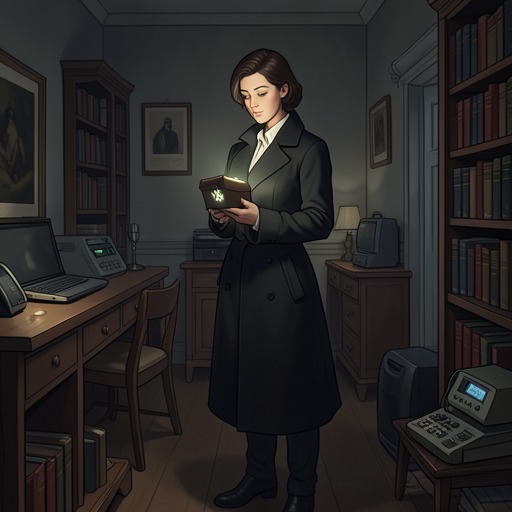
Panic RoomDitrimantelline is an experimental drug for multiple sclerosis whose effects become central to Holly Walsh’s story: she credits it with restoring control over her symptoms, but the treatment also links her personal health to anonymous payments, Harkness Pharmaceuticals, and the book’s wider nanobot plot. Its appearance as a labelled carton in Holly’s home makes the medicine at once an element of ordinary care and a trace of a much larger corporate system.
The medicine in Holly’s home
During a visit to Holly and Anna Marchant, Blake goes to the bathroom and notices a cabinet containing several medicines, including multiple cartons of Ditrimantelline. The packaging specifies ten-milligram tablets to be taken daily and warns against driving, operating machinery, or drinking alcohol while using the medicine. The label identifies Switzerland as its place of manufacture and names Harkness Pharmaceuticals. These practical details give the drug a concrete presence: it is not merely a treatment discussed in conversation, but a supply kept among the everyday things in Holly’s home.
The bathroom also contains wall-mounted grab handles to help Holly move around, alongside a knitted cover for the toilet lid and a yellow rubber duck beside the bath. The evidence does not make these objects part of the medicine’s operation, but their proximity places the cartons within a lived environment shaped by Holly’s illness and care. Blake’s attention to the medicine’s value and manufacturer turns a household observation into an investigative clue.
Holly’s treatment and reported effects
Holly has multiple sclerosis and writes online about living with the disease. In her blogs, she describes Ditrimantelline as an experimental treatment that has helped bring her symptoms under control. She says she can afford it because an anonymous benefactor pays for it, and presents the treatment as the reason she has regained a fuller life. Her account establishes the drug’s importance to her without making the narrative an independent medical assessment of its efficacy.
Holly explains that the benefactor first contacted her by email under the name Luscinia, Latin for nightingale. The sender claimed to work in pharmaceuticals, objected to the high cost of effective medicines, and offered to supply Ditrimantelline anonymously to avoid trouble. Holly had heard that the drug had been successful in the United States and accepted the offer. Anna Marchant confirms that the treatment has been transformative for Holly. Their testimony grounds the drug’s significance in its perceived benefit to the person taking it, rather than in corporate claims alone.
Supply, funding, and investigation
The carton’s Harkness Pharmaceuticals label immediately draws Don’s attention. Holly identifies the company as the maker, but Anna cautions that a manufacturer’s name on a box does not prove that the company produced the contents: an independent laboratory might supply a drug to Harkness. The scene therefore leaves a distinction between the product’s apparent corporate identity and the unresolved details of its actual production.
The money supporting Holly’s treatment is routed through the Nightingale account at Credit Suisse. A private investigator working for some of Harkness’s creditors has already visited Holly and asked about the payments. He did not, as far as she could tell, know about Jane Glasson; his interest was the money itself. Holly worries that Luscinia may be a Harkness employee diverting company funds to pay for her medication. If that is so, the support could end. The investigator had indicated that nothing was likely to change until Harkness’s case had gone through the American courts, a process that might take years if the company’s head were extradited.
Holly suspects that the investigator may know Luscinia’s identity. She asks Don to persuade him to disclose it, or at least to establish enough to show that the benefactor is not Jane. Don and Blake’s interest in the drug thus arises through two connected but distinct questions: who is paying for Holly’s treatment, and whether that secret funding can clarify another investigation. The medicine offers Holly practical hope while making her dependent on a supply and payment arrangement she cannot see for herself.
Place in the nanobot plot
Ditrimantelline later appears by name in an explanation of Harkness Pharmaceuticals’ nanobot program. The account states that people who have used the company’s drugs or cosmetics in the previous five years may have nanobots in their bloodstream; it also extends the claimed exposure to food produced using the company’s pesticides and meat from animals treated with its antibiotics. Ditrimantelline is listed alongside products such as Elixtris and Fenextris as part of this broad distribution through medicines and consumer products.
This later disclosure changes the scale at which the drug can be read. At first, the cartons signify a specific treatment whose reported benefit matters intensely to Holly. In the wider account, the same medicine belongs to a product network through which the company’s technology reaches many people. The earlier uncertainty about who manufactured the contents remains a relevant complication, but Ditrimantelline’s explicit inclusion in the program connects Holly’s private medical dependence to the book’s larger questions about pharmaceutical power, hidden exposure, and who controls what enters the body.